Visionbay Begins Design of K-1 AI Factory with 800 VDC-Ready Architecture for the Vera Rubin Era
2026/09/16
Visionbay has begun designing K-1, a next-generation AI factory platform in Asia that incorporates an 800 VDC-ready power architecture alongside NVIDIA Vera Rubin-class infrastructure planning and Vertiv 800 VDC power distribution systems.
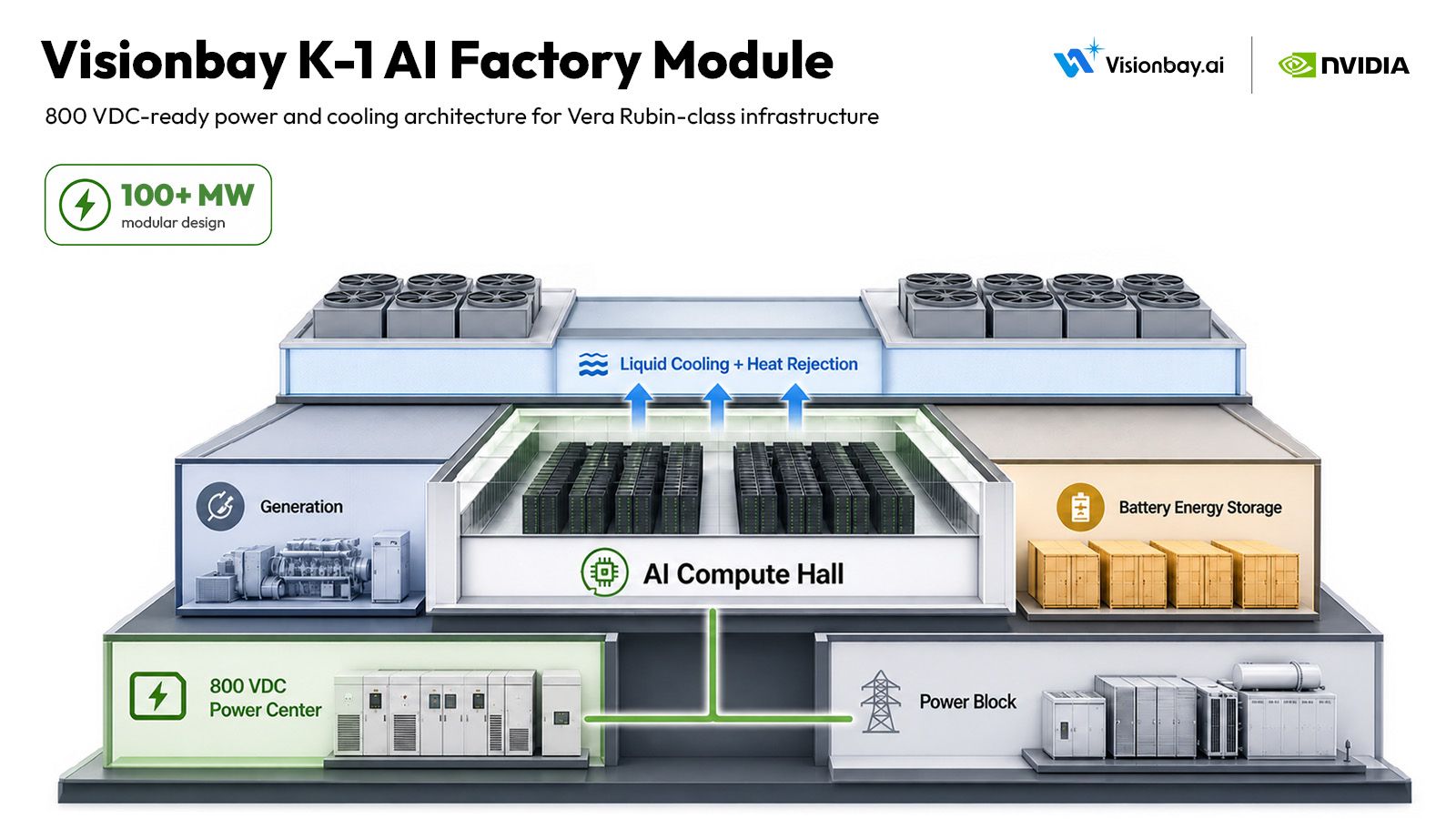 (Figure: Visionbay's K-1 module concept integrates data hall, power, generation, battery, and cooling infrastructure into a repeatable AI factory building block.)
AI factories are becoming the essential infrastructure of the intelligence era. As enterprises, AI labs, and nations transition from experimentation to production-scale AI, the demand for accelerated computing is growing rapidly.
These facilities are not traditional data centers; they are purpose-built factories that convert energy and data into intelligence, powering reasoning models, agents, scientific discovery, and digital services. This fundamental shift requires a re-imagination of facility design.
The K-1 Customer Proposition
K-1 gives data center operators a practical bridge from today’s AC-powered AI systems to future native 800 VDC compute. The design preserves near-term deployment flexibility while reducing the risk of stranded power infrastructure, disruptive retrofit, and constrained future rack density.
Because facility power systems typically serve several generations of compute, the decision is not simply which voltage to deploy today. It is how to build a long-lived infrastructure foundation that can accept higher-density platforms as the compute roadmap advances.
Designed for the Next Generation of AI
AI workloads are evolving rapidly. With training, fine-tuning, and inference scaling in tandem, and advanced reasoning applications increasing the compute required per interaction, we are facing a new infrastructure equation: more compute per rack, more heat per square meter, and unprecedented pressure on the power system.
High-density AI factories require a more scalable approach to power delivery. As rack power density rises, conventional low-voltage distribution becomes increasingly difficult to scale. High current introduces challenges in cabling, copper requirements, and the footprint consumed by power conversion equipment.
800 VDC architecture addresses these constraints by moving more power with lower current. This reduces distribution complexity, supports denser compute racks, and creates a cleaner, more efficient path from facility infrastructure to the GPU systems doing the work. Just as liquid cooling has become a necessity for high-density systems, 800 VDC is emerging as a practical foundation for the next phase of AI factory design.
For operators, the resulting opportunity is greater usable power capacity, less cable and equipment congestion, more room for productive compute, and fewer conversion stages between the utility source and the GPU. Actual benefits will depend on the selected topology, equipment, redundancy, protection strategy, and distribution distance.
A Practical Path to 800 VDC
Our K-1 strategy prioritizes pragmatism. The facility is not planned around a single, risky technology shift, but rather a phased migration.
Visionbay will deploy around proven AC infrastructure where appropriate, introducing 800 VDC closer to the compute load as high-density GPU clusters require it. This provides K-1 with a clear migration path from today’s deployments toward future native 800 VDC rack architectures.
By utilizing NVIDIA’s 800 VDC reference architecture, K-1 adopts the cluster-level Power Center architecture, centralizing AC-to-800 VDC conversion near the compute clusters. This flexibility allows us to deploy 800 VDC where it delivers the most immediate value, ensuring the facility remains adaptable as equipment, certification, and compute demand evolve.
K-1 Cluster-Level Power Center Architecture
K-1 will adopt Option B: cluster-level Power Centers serving groups of compute racks through 800 VDC busways and tap cans. This architecture provides a repeatable building block for new AI pods and phased campus expansion while preserving the facility’s proven medium-voltage and low-voltage AC infrastructure upstream of each Power Center.
- Repeatable deployment — standardized Power Center modules can be engineered, factory-integrated, qualified, and commissioned as cluster building blocks.
- Balanced capital phasing — capacity can be added cluster by cluster so infrastructure spending follows compute demand and utility readiness.
- Simplified downstream distribution — centralized rectification reduces repeated rack-level AC-to-DC conversion equipment and distributes 800 VDC closer to the compute load.
- Bounded operational risk — each cluster remains a defined power and maintenance domain, supporting sectionalization, redundancy, and service planning without creating a single hall-wide conversion dependency.
Why Readiness Matters: The 5G Analogy
The transition to 800 VDC is similar to the early adoption of 5G smartphones. When the first 5G-capable phones entered the market, network coverage was still limited. Customers nevertheless had confidence that broader service was coming and often selected a 5G-ready device rather than purchase equipment that would require replacement when the network became available.
Data center operators face a similar—but much larger and longer-lived—decision. Compute platforms evolve every few years, while facility power infrastructure may remain in service for decades. An 800 VDC-ready design does not require every part of K-1 to operate at 800 VDC on day one. It means reserving the topology, equipment space, distribution pathways, protection strategy, and cooling interfaces needed to introduce 800 VDC when the business case and compute platform require it.
The objective is not to pay for unused capability. It is to preserve access to the next generation without replacing the underlying facility platform.
Working Across the AI Infrastructure Ecosystem
No single company builds an AI factory alone. The K-1 project is the result of deep collaboration across the ecosystem:
- NVIDIA: Provides the compute platform direction and the reference architecture framework essential for planning Vera Rubin-class infrastructure.
- Vertiv: Brings critical expertise in thermal infrastructure, power systems, and the practical engineering required to support dense, liquid-cooled deployments.
This ecosystem approach reduces design uncertainty, providing our operators, partners, and suppliers with a shared framework for validating and scaling AI factory deployments.
A common architectural framework can also broaden the qualified supplier base. Multi-OEM participation can increase manufacturing capacity, improve sourcing flexibility, encourage interoperable solutions, and reduce dependence on a single equipment path. These advantages depend on common interface requirements, coordinated qualification, and clear system-level accountability.
Power and Cooling as a Unified System
K-1 is designed as an integrated AI factory module, rather than a conventional data hall with power and cooling bolted on as an afterthought. Our design unifies utility service, substations, power blocks, data halls, liquid cooling, generation, battery systems, and roof-mounted heat rejection into a coordinated plan.
Key design elements include:
- Staged Capacity Growth: Utilizing 22.8 kV facility distribution and 800 VDC Power Center integration.
- Distributed Redundancy: A 4-to-make-3 electrical design philosophy to support the project’s target availability and concurrent-maintenance objectives.
- Integrated Thermal Management: Incorporating roof-mounted air-cooled heat rejection alongside Vertiv XDU-class cooling systems to support megawatt-scale thermal loads.
- Power and Compute Optimization: Aligning the facility design with NVIDIA DSX MaxLPS principles to maximize AI factory performance per watt within a fixed power envelope, combining power-aware compute operation with high-temperature liquid cooling and infrastructure-level efficiency.
Liquid cooling is particularly vital for Vera Rubin-class deployments, where power density and heat removal must be engineered as a single, interdependent system.
Built for Deployment
The next phase of AI infrastructure will be defined by operational excellence. K-1 is engineered to turn high-level architectural concepts into deployable infrastructure, including power rooms, cooling loops, busways, and maintenance access points.
We are building for the long term, creating a facility foundation that can evolve alongside advancements in GPU platforms, rack power, and liquid cooling. K-1 stands on several core principles:
- Building for high-density systems from day one.
- Phasing deployment to manage risk and utility readiness.
- Integrating power and cooling into a single facility system.
- Aligning with NVIDIA’s AI factory architecture guidance.
- Working with ecosystem partners to accelerate readiness.
Preparing for the Vera Rubin Era and Beyond
AI factories are becoming the most strategic assets in the industrial landscape. As AI integrates deeper into production, these facilities must be increasingly scalable, efficient, and adaptable while keeping pace with rapidly evolving compute roadmaps. The challenge is not simply delivering more power, but enabling successive generations of higher-density compute without disruptive facility redesign.
Visionbay is designing K-1 to meet this future head-on. By adopting an 800 VDC-ready architecture, aligning with the NVIDIA roadmap, and collaborating with industry leaders like Vertiv, K-1 establishes a repeatable unit of growth. This architecture enables centralized power conversion, bounded fault domains, and a scalable path from today’s compute systems to future native 800 VDC racks.
We are not just building for a new voltage level; we are building a foundation that can scale with demand, support future GPU generations, and help our partners turn energy into intelligence.